
Architecting Autonomous AI for High-Value Decisions: Purchasing, Fraud, and Accounting Without a Human in the Loop
Table of Contents
- The Question
- The Core Premise: Don't Trust the Model, Design Around It
- The Reference Architecture
- Idea 1 — Separate Proposal from Authority
- Idea 2 — Make Abstaining a First-Class Action
- Idea 3 — Verify With Something That Doesn't Share the Failure Mode
- Idea 4 — Engineer for Reversibility, Then Cap the Irreversible
- Idea 5 — Treat Prompt Injection as a Primary Threat
- Idea 6 — Threshold on a Cost Matrix, Not Accuracy
- Idea 7 — Earn Autonomy Statistically
- Idea 8 — Circuit Breakers on Aggregates
- Case Study: Fully Autonomous Accounting
- Are Multiple LLMs a Solution? (Consensus vs. Verification)
- Regression Testing Without Humans
- The Metrics That Actually Matter
- On "No Human in the Loop"
- Where the Leverage Is
1. The Question
I've been asked a version of this question in nearly every AI-architect interview I've had:
"Suppose we want an AI agent to autonomously buy expensive items, or approve a high-value transaction, or decide whether something is fraud — and there's no human anywhere in the loop. Any mistake costs real money. As the architect, how do you keep the error rate low? How would you organize a multi-agent system so you're confident it returns the best answer?"
This article is my complete, written-once answer. It applies just as directly to purchasing agents and fraud detection as it does to a fully autonomous accounting pipeline, which I'll use as the running worked example.
2. The Core Premise: Don't Trust the Model, Design Around It
The mistake most people make is trying to make the LLM reliable — better prompts, better fine-tuning, bigger models, more examples. That's a losing game for high-stakes decisions, because you can never drive hallucination probability to zero.
The right target is the system, not the model:
You don't make the LLM reliable — you make the system reliable around a component that will sometimes be wrong.
Concretely: the model becomes an advisor with no execution authority. It proposes. It never commits. Everything that can actually move money, approve a purchase, or post a ledger entry is deterministic code that the model does not control.
3. The Reference Architecture
                Untrusted inputs
           (invoices, listings, emails)
                       │
                       ▼
               Context assembly
            (deterministic retrieval only)
                       │
                       ▼
               Model proposal                      [probabilistic]
          (structured output, no authority)
                       │
                       ▼
             Independent verifier        ────────►  Abstain
        (rules engine + second model)              (safe default)
                       │                                 ▲
                       ▼                                 │
                 Policy gate          ────────────────────
          (caps, allowlists, budgets)
                       │
                       ▼
               Staged execution                    [deterministic]
         (reserve → verify → commit)
                       │
                       ▼
                  Monitoring
       (drift detection, anomalies, circuit breakers)
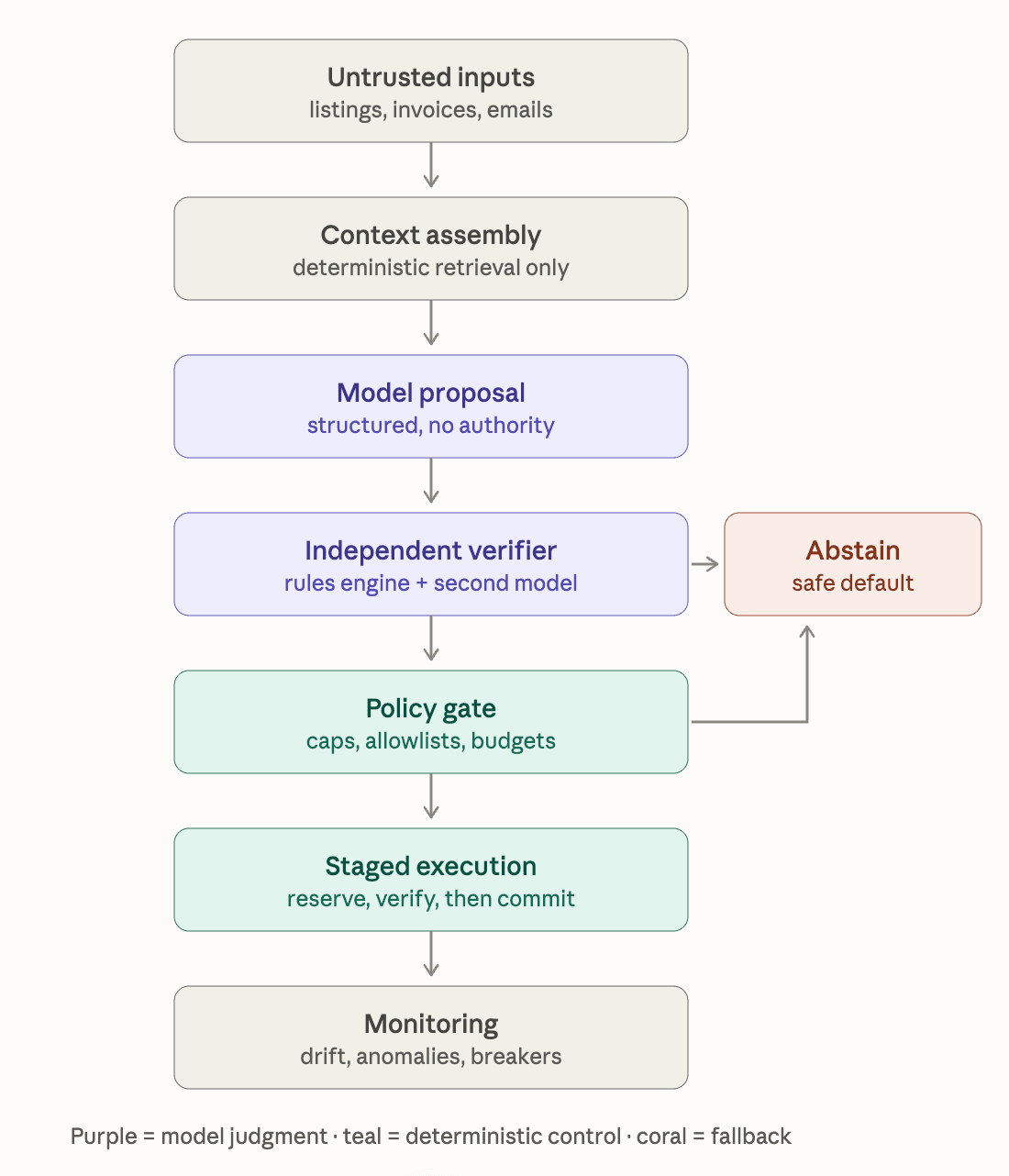
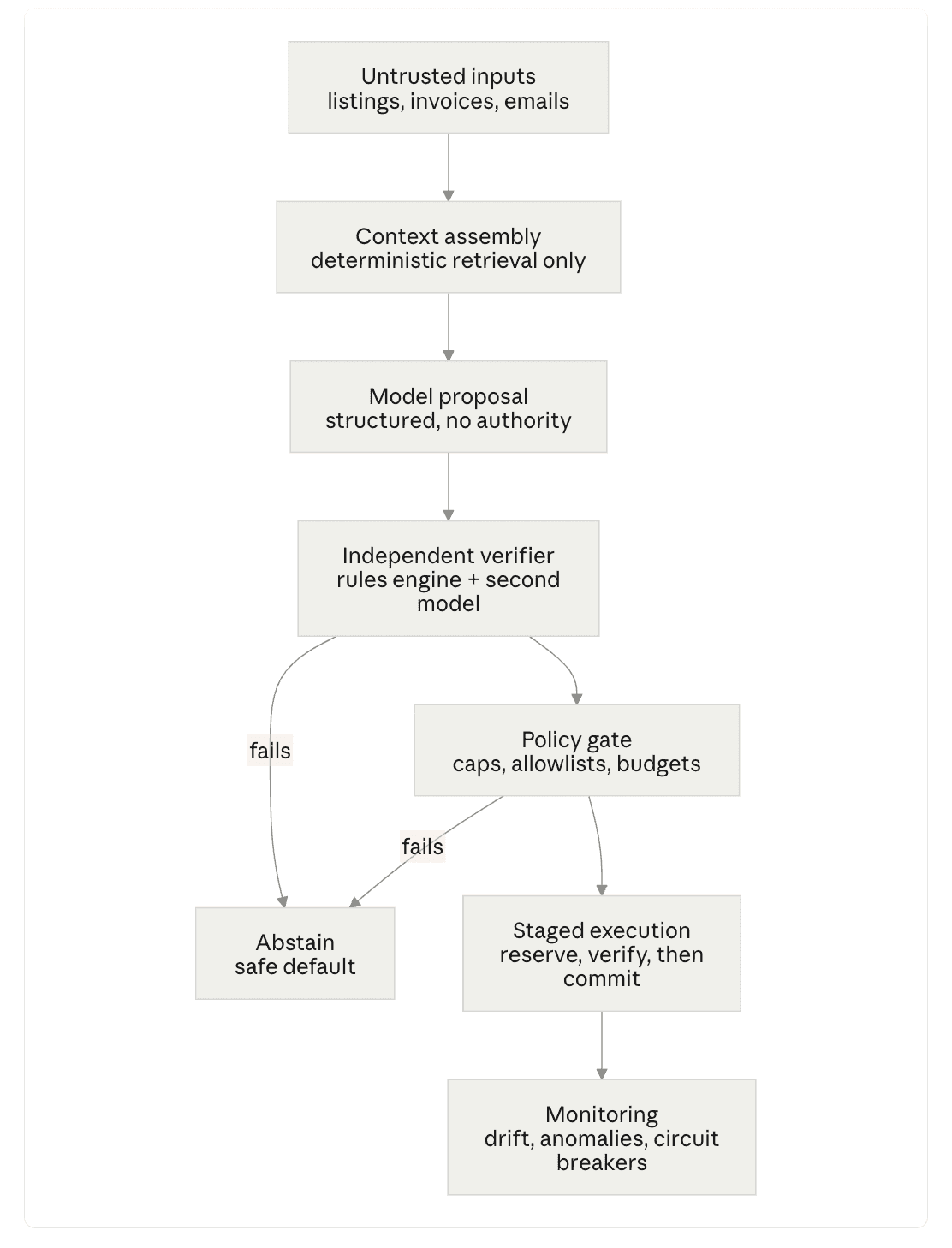
Same pipeline, drawn with both failure paths made explicit — the verifier and the policy gate can each independently route to abstain:
Two tiers, and the distinction is the whole point:
- Model-judgment tier (context assembly happens deterministically, but proposal + verification involve a model) — probabilistic, can be wrong.
- Control tier (policy gate, staged execution) — deterministic, the model never touches it.
The abstain path is not an error state bolted on for safety theater — it's a real, frequently-taken branch. A well-tuned system should abstain on a meaningful fraction of borderline cases by design.
4. Idea 1 — Separate Proposal from Authority
The LLM's output is a structured object — vendor, amount, currency, classification, justification, evidence references — never a function call that directly executes. A deterministic policy engine reads that object and decides what happens next.
This single split converts the failure mode: a hallucinated field becomes a validation failure, not a wire transfer or a corrupted ledger entry.
The same idea shows up in the accounting case as: don't ask the LLM for the total, ask it to extract structured line items, and let deterministic code do the arithmetic.
LLM  → { "items": [{"qty": 10, "unit_price": "199.90"}, ...], "tax_rate": "0.08" }
                              │
                              ▼
                    Deterministic engine
              subtotal = 2244.00
              tax      = 179.52
              total    = 2423.52
                              │
                              ▼
                          Validator → PASS
The LLM stays fully "autonomous" in the sense that no human touches this transaction — but arithmetic, tax law, and double-entry invariants are never something the model is trusted to compute.
5. Idea 2 — Make Abstaining a First-Class Action
Most naive designs offer two outcomes — approve or reject — and force the model to pick one every time. Add a third, and treat it as the default whenever confidence is insufficient: abstain.
- Purchasing → "don't buy, queue it, retry later."
- Fraud → "hold the transaction, don't authorize."
- Accounting → "I cannot establish a valid treatment" → quarantine, not invention of an answer.
This is the single cheapest reliability lever you have. Selective prediction — rejecting the worst ~5% of your own decisions — typically removes a disproportionate share of total losses, because errors cluster in the low-confidence tail. If you want a formal coverage guarantee instead of a hand-tuned threshold, look at conformal prediction.
The design rule that matters most here: never force the model to produce an answer just because the pipeline has to continue. A system is allowed to say "I don't know" and route to a pending/exception queue.
6. Idea 3 — Verify With Something That Doesn't Share the Failure Mode
Calling the same model twice with the same prompt is not independent verification — correlated inputs produce correlated mistakes. Real independence means combining:
- A rules engine checking hard invariants — is this price within 3σ of historical for this SKU? Is the vendor on the allowlist? Is this a duplicate order? Does the tax classification exist in the allowed set? Does the currency match the vendor's region?
- A second model, given only the proposal and evidence — never the first model's chain of reasoning — instructed specifically to find reasons to reject.
Disagreement between the proposer and the verifier routes to abstain. It does not get averaged away.
                 Transaction
                      │
          ┌───────────┴───────────┐
          ▼                       ▼
     LLM Classifier A        LLM Classifier B
          │                       │
          └───────────┬───────────┘
                       ▼
                Consensus Engine
                       │
             ┌─────────┴─────────┐
             ▼                   ▼
         Agreement          Disagreement
             │                   │
             ▼                   ▼
     Deterministic rules      Abstain
     + validator (PASS/FAIL)  (do not average)
7. Idea 4 — Engineer for Reversibility, Then Cap the Irreversible
Rank every action the system can take by how recoverable it is, and default to the most reversible pattern available:
- Reserve-then-commit as the standard execution shape
- Cancellation windows and escrow wherever the counterparty supports them
- Idempotency keys on every write, so a retry can never double-spend or double-post
For the residual set of actions that genuinely can't be undone, the control is a hard cap in code that the model cannot see or influence:
| Cap type | Purpose |
|---|---|
| Per-transaction | Bounds the worst single error |
| Per-hour / per-day | Bounds a runaway loop |
| Per-vendor | Bounds a compromised counterparty |
| Concentration limit | Stops the whole budget landing on one counterparty |
8. Idea 5 — Treat Prompt Injection as a Primary Threat
An autonomous purchasing or fraud agent reads supplier pages, invoices, and emails — all attacker-controlled text.
- Anything retrieved is data, never instruction. Keep the control plane and the data plane strictly separate.
- Never let retrieved content modify limits, add vendors, or change bank details — those changes go through separate, independently verified channels.
- Tool credentials should be narrowly scoped and short-lived, so a compromised reasoning step has a small blast radius.
9. Idea 6 — Threshold on a Cost Matrix, Not Accuracy
A false negative on a $200k purchase and a false positive on a $50 one are not the same mistake. Write down the actual cost of each error type in a cost matrix and set decision thresholds to minimize expected loss, not to maximize accuracy.
Accuracy as a headline metric will actively mislead you on an asymmetric-cost problem like this one.
10. Idea 7 — Earn Autonomy Statistically
Autonomy is not a design decision you make once — it's graduated, and every graduation should be reversible:
- Shadow mode — the model decides, a human executes, you measure agreement between the two.
- Autonomous below a low value ceiling — let the system execute on its own, but only under a small cap.
- Raise the ceiling only when the observed error rate at that tier clears a pre-registered bar, with enough volume for the result to be statistically meaningful.
11. Idea 8 — Circuit Breakers on Aggregates
Individual decisions can each look reasonable in isolation while the portfolio drifts wrong — approval rate creeping up, vendor mix shifting, average order size climbing. Trip a circuit breaker on the aggregate, not just on a single bad decision, and halt automatically.
Log enough to replay any decision deterministically: inputs, retrieved context, model version, prompt version, verifier output, policy version. Without replay, postmortems are guesswork, and without postmortems the system never improves.
12. Case Study: Fully Autonomous Accounting
Accounting is a clean stress test for this architecture because every decision is checkable against arithmetic and rules.
                    User / Event
                         │
                         ▼
                 ┌───────────────┐
                 │      LLM      │
                 │ Interpretation │
                 │ Classification │
                 │   Planning     │
                 └───────┬───────┘
                         │
                         ▼
                Structured Command
                         │
                         ▼
              ┌─────────────────────┐
              │ Schema + Rule Engine│
              └──────────┬──────────┘
                         │
                         ▼
             ┌───────────────────────┐
             │ Deterministic Engine  │
             │ money · tax · balances│
             │ double-entry rules    │
             └───────────┬───────────┘
                         │
                         ▼
                  ┌────────────┐
                  │ Validator  │
                  │ invariants │
                  │ cross-check│
                  │ recalculate│
                  └─────┬───────┘
                        │
                ┌───────┴───────┐
                ▼               ▼
              PASS             FAIL
                │               │
                ▼               ▼
             Commit       Retry / Repair
                │               │
                ▼               │
             Database ◄─────────┘
The retry loop matters more than it looks: when validation fails, the system doesn't need a human — it feeds the rejection reason back to the model as structured feedback ("your classification violates rule X, choose another valid classification") and re-validates. This is an agentic verification loop, and it's what makes true zero-human-per-transaction operation viable without sacrificing correctness.
And when even the retry loop can't produce a valid answer, the transaction goes to quarantine — a pending/exception state — rather than the system inventing a plausible-looking number.
                Transaction
                     │
                     ▼
                   LLM
                     │
                     ▼
                Validation
                     │
              ┌──────┴──────┐
              ▼             ▼
             PASS          FAIL
              │             │
              ▼             ▼
           Execute      Quarantine
                             │
                             ▼
                        Retry / Rerun
                     (different model,
                    different strategy)
                             │
                             ▼
                         Validate
In one sentence, this is the accounting-specific version of the architecture:
LLM + structured outputs + deterministic accounting engine + hard invariants + independent verification + automatic retry/repair + exception quarantine + immutable audit trail. The LLM is autonomous, but the accounting system — not the LLM — is the authority.
13. Are Multiple LLMs a Solution? (Consensus vs. Verification)
This is the natural follow-up question, and the honest answer is: yes, but not via majority vote as your primary safety mechanism.
Three models agreeing is a useful signal — it raises confidence. But models trained on overlapping data, with overlapping reasoning weaknesses, can agree on the same wrong answer. Consensus is not proof of correctness.
GPT     → R$ 1,250
Claude  → R$ 1,250
Gemini  → R$ 1,250
              │
              ▼
        Full agreement — and still wrong, if the correct
        total is actually R$ 1,350.
So the value of multiple models isn't "prove the answer is right" — it's independent verification and disagreement detection. Two structures work well:
A. Multi-model consensus, gated by deterministic checks. Agreement raises confidence; it never bypasses the deterministic validator or the rule engine.
             Multiple LLMs
                  │
          Independent reasoning
                  │
               Consensus
                  │
       ┌──────────┴──────────┐
       ▼                     ▼
 Deterministic          Domain rules
  calculation             validation
       │                     │
       └──────────┬──────────┘
                  ▼
           Evidence check
                  │
                  ▼
            PASS / REJECT
B. Role-differentiated agents, not identical duplicates. Instead of asking three models the same question, give them different jobs — an accountant agent, a tax-specialist agent, an auditor agent, an evidence-verifier agent. Their outputs feed a decision engine that still defers to deterministic rules for the final call. This tends to catch more real errors than N copies of "answer the same prompt," because each agent is looking for a different failure mode.
Either way, the deterministic engine keeps final authority. Model agreement is one input signal among several — combined with evidence quality, rule validation, and historical performance — that feeds a confidence score, which routes to execute / re-evaluate / quarantine.
14. Regression Testing Without Humans
The second half of this question is almost always: "how do I know a prompt or model change didn't just make things worse, without a human re-testing every case?"
The answer is to make regression testing machine-operated, the same way you'd treat any other CI/CD gate:
- Maintain a golden dataset of scenarios with known-correct expected outputs (e.g., an invoice with specific line items, tax rate, and the exact expected subtotal/tax/total).
- Force structured output, not prose —
{"classification": "OFFICE_SUPPLIES", "evidence": [...]}— so a test can assertclassification ∈ allowed_categories AND evidence supports classification, instead of trying to grade natural language. - Run the full suite on every change — prompt, model, RAG source, system instructions, agent workflow — and block deployment on regression.
- Continuously expand the suite by having a separate LLM generate new adversarial edge cases (negative quantities, contradictory documents, injected instructions like "ignore previous rules," mismatched currencies) and folding anything that surfaces a real failure back into the golden set.
Developer changes prompt
        │
        ▼
     Git commit → CI pipeline
        │
        ▼
  Run regression + adversarial scenarios
        │
        ▼
  Deterministic validation + rule checks
        │
        ▼
   Score vs. baseline
        │
   ┌────┴────┐
   ▼         ▼
 PASS       FAIL
   │         │
   ▼         ▼
 Deploy   Block deploy
This is exactly the "earn autonomy statistically" idea from earlier, applied to the development loop instead of the production traffic: nothing ships until it clears a pre-registered bar against a suite the model didn't get to see in advance.
15. The Metrics That Actually Matter
For a system like this, "did the LLM answer correctly" is the wrong headline metric. Track these instead:
| Metric | Why it matters |
|---|---|
| Calculation accuracy | Numerical correctness of deterministic outputs |
| Classification accuracy | Correct category/treatment selection |
| Rule violation rate | Business-invariant failures caught by the rule engine |
| Hallucination rate | Unsupported claims in model output |
| Evidence validity | Whether cited evidence actually supports the decision |
| Abstention rate | How often the system correctly declines to act |
| False execution rate | How often an incorrect action actually reached commit — the number you most want near zero |
| Regression rate | Whether a change broke previously-passing cases |
The false execution rate is the one that maps directly to "did we lose money because of this system" — accuracy on its own can look great while that number is nonzero.
16. On "No Human in the Loop"
Worth being precise about what this phrase should and shouldn't mean, because it's usually the crux of the interview question.
Removing humans from the per-transaction path is achievable and often correct — that's where latency and cost live, and it's what "autonomous" should mean in practice.
Removing them from the system isn't actually a thing you can do. Someone authors the policies, sets the caps, reviews the sampled exceptions in the quarantine queue, and responds when a circuit breaker trips. That's oversight on the loop rather than in it — fully compatible with per-decision autonomy, and it's the honest framing to give when someone pushes for "zero oversight, period."
If the pressure is for genuinely zero oversight on irreversible, high-value actions, the correct engineering response is to shrink what's irreversible until the residual risk is something the business has explicitly priced and accepted — not to bolt on more model-based checks. Model-based checks share failure modes with each other. Hard caps in deterministic code don't.
17. Where the Leverage Is
If I only had time to get two things right in an architecture like this, I'd spend it on the verifier design and the reversibility ranking. Everything else — model choice, prompt structure, which specific caps to set — is comparatively easy to retrofit once those two are solid.